petrol prices in india
Advertisement
Your ad could be here
Petrol prices across India remain a key economic concern as global crude oil fluctuations, government tax policies, and exchange rate pressures continue to shape fuel costs for millions of consumers.
The Background
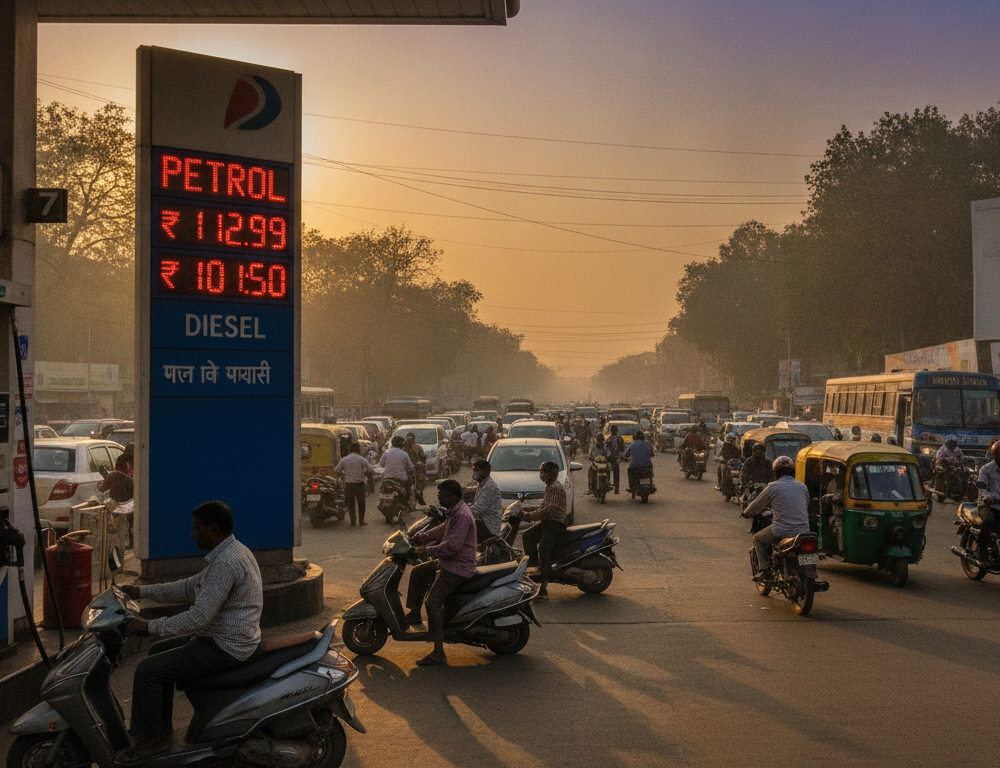
Fuel prices in India have once again come under the spotlight as consumers, economists, and policymakers grapple with the complex web of factors that determine what citizens pay at the pump. With petrol remaining one of the most price-sensitive commodities in the country, any movement — upward or downward — has far-reaching consequences for households, businesses, and the broader economy. As of the latest revisions by state-owned oil marketing companies (OMCs) — Indian Oil Corporation (IOC), Bharat Petroleum Corporation Limited (BPCL), and Hindustan Petroleum Corporation Limited (HPCL) — petrol prices in major Indian cities reflect a combination of international crude oil benchmarks, central and state government taxes, dealer commissions, and freight charges. In Delhi, petrol is currently priced at approximately ₹94.77 per litre, while Mumbai — which traditionally records higher prices due to state-level levies — sees rates hovering around ₹103.44 per litre.
Key Developments
Cities like Chennai and Kolkata report figures in the range of ₹100–₹101 per litre, underscoring the significant role that state taxes play in regional price disparities. India imports nearly 85% of its crude oil requirements, making it acutely vulnerable to global price movements. The recent volatility in international crude markets, influenced by OPEC+ production decisions, geopolitical tensions in the Middle East, and demand fluctuations from major economies like China and the United States, has kept Indian energy authorities on high alert. When Brent crude trades above the $85–$90 per barrel threshold, the pressure on domestic fuel prices intensifies, often prompting public debate about the government's pricing mechanism and subsidy framework.
The Bigger Picture
A critical structural issue in India's fuel pricing is the substantial tax burden embedded in retail petrol prices. Central excise duty and state VAT (Value Added Tax) together account for nearly 50–55% of the final retail price in many states. Critics, including opposition politicians and consumer rights advocates, argue that the government's heavy reliance on petroleum taxation as a revenue source insulates it from passing on global price relief to citizens. "The common man does not benefit when crude oil prices fall internationally, because the government absorbs that margin through taxes rather than reducing retail prices," noted an energy economist at a leading Delhi-based think tank.
Global Market
"This asymmetry is a structural flaw in India's fuel pricing architecture." The dynamic fuel pricing system, introduced in 2017 to align domestic prices more closely with global market rates, was initially hailed as a progressive reform. However, in practice, OMCs have often maintained prices for extended periods without revision — particularly ahead of state elections — raising questions about the true independence of the pricing mechanism. The government last undertook a significant across-the-board reduction in fuel prices in May 2022, when it cut excise duty on petrol by ₹8 per litre amid soaring inflation, providing temporary relief to consumers. Electric vehicle (EV) adoption is increasingly being discussed as a long-term solution to India's dependency on fossil fuel imports.
Adoption
The government's push under schemes like FAME (Faster Adoption and Manufacturing of Hybrid and Electric Vehicles) aims to reduce petrol demand over the next decade. However, experts caution that the infrastructure gap and the high upfront cost of EVs mean that petrol will remain the dominant transport fuel for the foreseeable future, keeping fuel price policy at the centre of economic and political discourse. Looking ahead, analysts suggest that petrol prices in India are likely to remain stable in the near term, provided international crude stays within manageable bounds and the rupee does not depreciate sharply against the US dollar. However, any escalation in global geopolitical tensions or a supply shock from major oil-producing nations could quickly alter that outlook.
Global Energy
For the average Indian consumer, the price of petrol continues to be far more than just a number at the fuel station — it is a barometer of economic well-being, government policy, and India's place in an interconnected global energy market.
Contributor, Peepals Global · AI-assisted, human-edited
US and Iran Sign Historic Peace Memorandum, Ending Four-Month War and Reopening Strait of Hormuz
World Markets Rally as Major Economies Signal Coordinated Rate Cuts
This article was drafted with AI assistance and reviewed by a Peepals editor before publication.
Advertisement
Your ad could be here